
Home › Coverages › Workers' Comp Insurance for Electricians
Workers' comp for electrical crews
Workers' compensation for electricians pays medical care and lost wages when someone on your crew is hurt on the job, and most states require it once you hire. The price is built from payroll in each class code, so the codes on your policy decide what you owe at audit.
- Since 2003
- 12+ A-rated carriers
- 28 states
- Independent agents
Start your electrician insurance quote
Takes about a minute. A licensed agent follows up.
Licensed in 28 states · NPN 7642818 · Since 2003
How workers compensation for electricians works
Workers' compensation for electricians covers your own people. When a journeyman falls off a step ladder or an apprentice takes an arc-flash burn, the policy pays the medical bills and wage benefits your state's law sets.
A standard policy has two parts. Part One pays those state-required benefits. Part Two, employer's liability, handles the injury lawsuits that slip past the comp system. A common one: your tech sues the building owner, and the owner turns around and sues you.
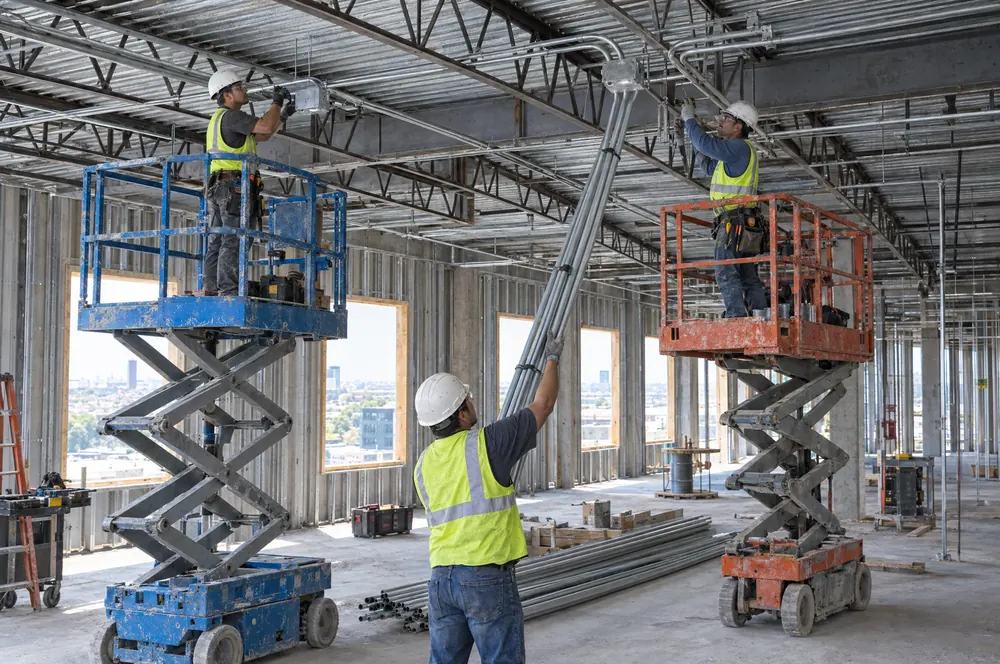
Falls are the big driver in construction. OSHA reports 389 of the 1,034 construction deaths in 2024 were falls to a lower level, and fall protection is its most-cited standard. Ladders, lifts and roofs are where an electrical crew meets that risk. Add shock, arc flash, cuts from stripping MC cable and strained backs from wire pulls, and you can see why underwriters price electrical payroll by the type of work, not just headcount.
| Usually covered | Usually not covered |
|---|---|
| Medical care for job injuries: falls, shocks, burns, cuts | Injuries to customers or the public (general liability) |
| Part of lost wages while an employee recovers | Harassment, discrimination or firing claims (EPLI) |
| Defense when an employee injury turns into a lawsuit | Subs who carry their own comp, once you hold their certificate |
| Third-party-over and dual-capacity suits under Part Two | Owners or officers who opt out, where your state allows it |
Where comp claims come from on electrical jobs
These are fictional examples. How a real claim resolves depends on your state, your policy and the facts.
The MCC bucket
Example scenario: A journeyman troubleshooting a starter in a plant's motor control center gets second-degree burns on his hands and face when a fault flashes over. Comp covers the burn unit, follow-up care and weekly wage benefits while he's off the job.
The rooftop array crew
Example scenario: An Indiana shop wires a rooftop array on a warehouse. Two installers spend a week setting modules while a journeyman lands the DC conductors and the inverter. Under NCCI's scopes, rooftop panel installation is classed as roofing (5551) and the electrical work as 5190. Indiana's 2026 advisory rates put those at $4.160 and $0.901 per $100 of payroll, so how the time cards split matters at audit.
The Texas attic
Example scenario: A Houston-area service shop has opted out of comp. A helper steps between ceiling joists and falls through into a living room. He sues for negligence, and as a non-subscriber the shop can't argue that he was careless or that he accepted the risk.
Audits, rates and what workers comp for electrical contractors costs
Your premium starts as payroll divided by 100, times the rate for each class, then your experience mod adjusts it. The premium you pay up front is only a deposit, set from the payroll you expect. After the year ends, an auditor checks actual payroll by class and bills or refunds the difference.
Subs are the classic audit surprise. If a sub can't show a comp certificate, the auditor may count them as your payroll: at least 90% of a labor-only contract or 50% of a labor-and-materials contract when their real payroll isn't available. Collect certificates before they start. Our guide to 1099 subs and comp covers the details.
For scale, Indiana's 2026 advisory rate for 5190 is $0.901 per $100 of payroll, against $1.277 for conduit work and $1.428 for line work. Carriers file their own deviations, and other states differ. What you pay depends on your payroll and class codes, revenue, loss history, the type of electrical work you do and the limits you pick. Get a quote for your electrical business →
Who needs it most
Any shop with employees, and in most states that means your first apprentice or helper. The stakes climb with the work. Commercial and industrial shops work at height, near energized gear and on GC sites that often won't let a crew through the gate without a comp certificate. Utility and line contractors run payroll in 7538 and 6325, both rated above inside wiring in Indiana's 2026 filing. Growing shops also get audited on payroll they never reported, so call us before a big hiring push, not after.
Ohio, Texas and the gaps comp doesn't fill
Ohio: state fund plus stop-gap
Ohio comp comes only from the Bureau of Workers' Compensation, unless you qualify to self-insure. Carriers don't quote it. The BWC policy has no employer's liability, so Ohio shops usually add stop-gap employer's liability as an endorsement on their GL, which private carriers can provide.
Texas non-subscribers
Texas lets most private employers skip comp. Non-subscribers must notify employees, and they lose key defenses if an injured worker sues. Public building and construction contracts still require comp, subs included. Talk to a Texas employment attorney before opting out.
Occupational accident insurance
Occupational accident pays scheduled medical and wage benefits after a work injury. It isn't workers' comp and doesn't restore the defenses a Texas non-subscriber gives up. It's used by non-subscribers and some 1099 owner-operators.
Employment practices liability (EPLI)
Comp and GL don't cover claims of wrongful firing, discrimination, harassment or retaliation from employees or applicants. EPLI does, usually on a claims-made basis, and defense costs often reduce the limit. It's worth a look once you're hiring and letting people go. Get a quote for your electrical business →
Workers' comp requirements by state
The hiring trigger varies. Florida requires comp for construction employers with even one employee. Illinois treats electrical work as extra-hazardous, with no headcount threshold. Georgia, North Carolina and Virginia start at three regular employees. Michigan starts at three, or sooner once a single worker has put in 35-plus hours weekly for 13 weeks. See Florida, Illinois, North Carolina and Michigan.
Ohio and Texas run on the rules above; see Ohio and Texas. Owner exemptions differ everywhere, so confirm yours with your state's comp agency or state page.
Coverage that pairs with workers' comp
Frequently asked questions
What is the workers comp class code for electricians?
Does hiring one apprentice mean I need workers comp?
Why did I get a bill after my workers comp audit?
Can I buy Ohio workers' comp from an insurance company?
Can occupational accident coverage replace workers comp?
Ready to see what you'd pay?
Independent agents, 12+ A-rated carriers, and a licensed agent back to you within one business day.