
Home › Coverages › Solar, EV & Low-Voltage Contractor Insurance
Insurance for solar, EV charger and low-voltage contractors
Solar contractor insurance, EV charger installer coverage and low-voltage contractor insurance all start with the same core policies any electrical shop carries. What changes is the fine print: roof limits, comp class, battery fire exposure, design errors and alarm failures each need to be set up on purpose before the first job.
- Since 2003
- 12+ A-rated carriers
- 28 states
- Independent agents
Start your electrician insurance quote
Takes about a minute. A licensed agent follows up.
Licensed in 28 states · NPN 7642818 · Since 2003
Where solar contractor insurance claims start
Solar contractor insurance has to answer for crews on roofs, energy stored in garages and numbers customers rely on. Most losses in this segment trace back to one of four things.
Height
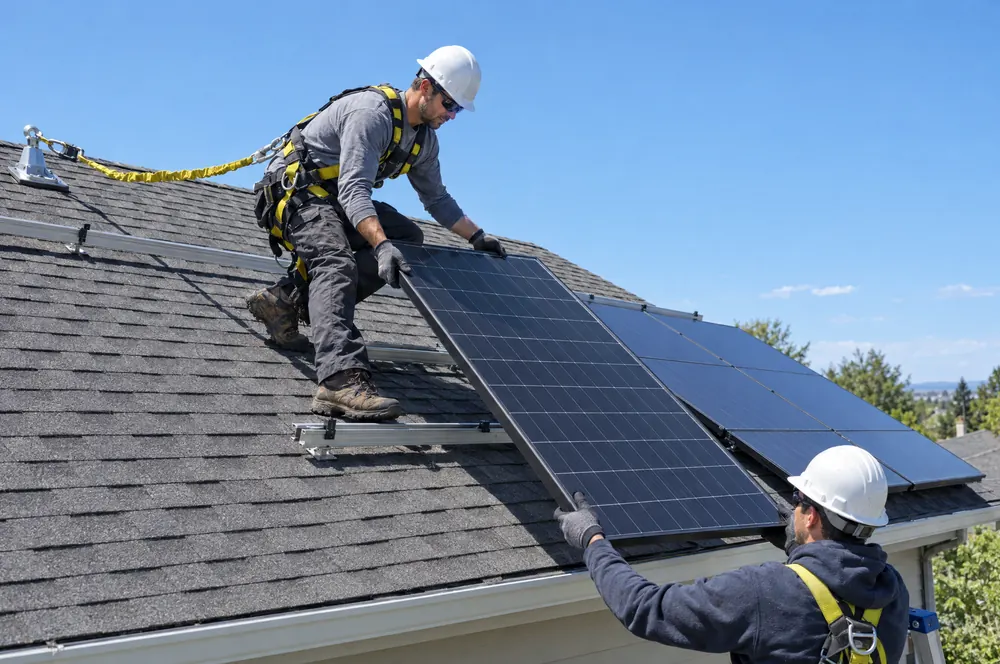
Rooftop PV crews spend the day on pitched roofs, ladders and lifts. Across all of construction, falls to a lower level caused 389 of the 1,034 on-the-job deaths in 2024, per BLS data reported by OSHA. Fall protection (29 CFR 1926.501) is also the standard OSHA cites most, with construction ladders and scaffolding in its top 10 too.
Those are construction-wide figures, not solar numbers. They still explain why comp underwriters grill you about roof crews.
Stored energy
An array makes DC power whenever light hits it, and a home battery holds a charge with the main breaker off. A bad termination on either can sit quietly for months before it heats up.
Numbers customers rely on
Production estimates, string sizing and EV load calcs are advice. When the advice is wrong, the claim isn't about a broken part. It's about money the customer says they lost.
Systems that have to work unattended
Fire alarm, intrusion and access-control systems exist for the night nobody is home. When one stays silent, the claim lands on whoever installed or serviced it.
The coverage stack for solar, EV and low-voltage work
The first four are must-haves for almost every shop in this segment. The last two follow the work you sell.
General liability (must-have)
Injury and property damage to others, plus completed operations, which picks up a fire or failure months after closeout. General liability for electricians
Workers' comp (must-have)
Covers your installers and techs, priced by class code. Roof crews and wiring crews may rate very differently. Workers' comp for electricians
Installation floater (must-have for PV and storage)
Modules, inverters, racking and batteries you're installing, from delivery until the system is accepted. Installation floater coverage
Tools and equipment (must-have)
Meters, torque tools, crimpers, cable testers and fish tapes, on the truck or on the roof. Tools and equipment insurance
Professional liability (often needed)
System design, production estimates, load calcs and alarm system layouts. Professional liability (E&O)
Umbrella (often needed)
Extra limits when a commercial owner, utility program or GC asks for more than your GL and auto carry. Umbrella insurance
Roof work: check the GL endorsements and the comp class
PV arrays and batteries: long-tail fire risk and design errors
EV chargers: the load calc is the exposure
Example scenario
Fire alarm, security and low-voltage work
What owners, utilities and GCs will ask you for
Commercial PV and charger jobs usually come with an insurance exhibit. Expect additional insured status, waiver of subrogation and primary and non-contributory wording, all added by endorsement. A certificate alone doesn't create any of them.
Utility incentive programs set their own floors. In Texas, CPS Energy's solar program manual calls for $1,000,000 per occurrence, and Austin Energy's contractor handbook asks for $500,000 of GL, workers' comp and $500,000 of auto. Illinois requires distributed generation installers to be certified by the Illinois Commerce Commission.
Then there's the gear before commissioning. Modules, inverters, racking and batteries delivered to a site are your materials until the job is accepted, and a tools policy isn't built for them. Ask how your installation floater handles theft from the site and storage at your yard. A pallet of batteries or a commercial inverter may need its own limit.
Growing a solar, EV or low-voltage shop
Each new line of work is a coverage event, not just a sales win. Call us before these milestones, not after:
- Your first rooftop array. Classification, height endorsements and the 5551 payroll split.
- Your first ground mount. Different comp class, and often a different site-theft picture.
- Your first battery install. Completed-operations wording, listing records and floater limits.
- Your first monitoring contract. Monitoring is its own GL class and usually needs alarm E&O.
- Your first design-build job. E&O is claims-made, so keep the retroactive date unbroken when you renew or switch carriers.
As commercial work grows, contract limits often climb past $1M per occurrence and $2M aggregate. An umbrella is usually how shops reach them without rebuilding every policy.
Frequently asked questions
Do solar installers need different insurance than regular electricians?
What workers' comp class code is solar panel installation?
Does general liability cover an EV charger install that causes a fire?
Do low-voltage contractors need professional liability?
Will my tools policy cover solar panels stolen from a jobsite?
Ready to see what you'd pay?
Independent agents, 12+ A-rated carriers, and a licensed agent back to you within one business day.