
Home › Coverages › Tools & Equipment Insurance for Electricians
Tools and equipment insurance for electricians
Electrician tool insurance, usually written as a contractors equipment floater, pays to repair or replace meters, thermal cameras, pullers and benders that are stolen or damaged in the van, on the job or at the shop. Set up right, it can also reach lifts you rent and the wire stock you carry.
- Since 2003
- 12+ A-rated carriers
- 28 states
- Independent agents
Start your electrician insurance quote
Takes about a minute. A licensed agent follows up.
Licensed in 28 states · NPN 7642818 · Since 2003
How contractors equipment insurance works for an electrician
Contractors equipment insurance falls under inland marine, the family of policies that follow property instead of staying at one address. The meter on a tech's belt, the cable puller in the box truck and the bender at the shop are all covered wherever they are, up to the policy's terms.
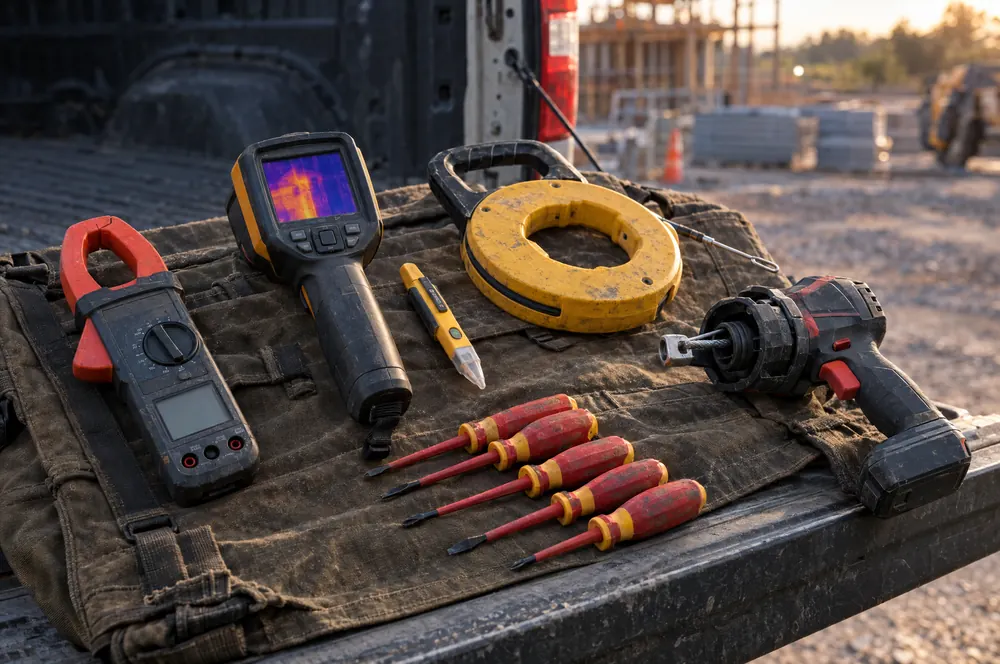
Most floaters handle gear two ways. Hand tools and small power tools are covered as a group, often with a cap on any one item. Higher-value pieces are listed one by one with a value for each: a cable puller, a hydraulic bender, a thermal imager, a power-quality analyzer, a fault locator. That's called scheduling.
Your auto policy won't fill this gap. It covers the van and the racks bolted into it, not the loose gear riding inside. Commercial auto for electricians explains where that line falls.
The gear electrical shops usually schedule
Start with the list of anything you'd have to rent or rebuy before the next job could start. For most shops it looks like this:
- Test and diagnostic: thermal imager, insulation resistance tester, power-quality analyzer, underground fault locator, circuit tracer
- Pulling and bending: cable puller or tugger, hydraulic and electric benders, pipe threader
- Cutting and terminating: battery crimpers and press tools, hydraulic knockout sets, cable cutters for large conductors
- Access: rolling scaffold, extension ladders and any lift you own outright
Keep serial numbers, receipts and a few photos of each scheduled item somewhere off the van, like a shared drive. If something walks off a job, that file is what proves what you had and what it was worth. Update the schedule when you buy, so a new $6,000 imager isn't stuck under a small-tool cap.
| Usually covered | Usually not covered |
|---|---|
| Theft of tools from the jobsite, the shop or the van, subject to the policy's conditions | Property that simply goes missing with no evidence of what happened |
| Damage from drops, falls, fire and vehicle accidents | Electrical damage to electrical testers on some floaters, unless fire follows |
| Named high-value instruments at their scheduled value | Materials you're installing, which belong on an installation floater |
| Rented or borrowed gear listed on the policy | The van itself (commercial auto) |
| Rental costs while your own covered equipment is being replaced | Wire stock, unless the policy lists stock or materials |
What electrician tool insurance looks like in practice
These scenarios are invented to show how the coverage tends to work. Your policy wording decides any real loss.
The rented scissor lift
Example scenario: A commercial shop rents a 26-foot scissor lift for a warehouse lighting retrofit. A forklift operator from another trade backs into it and bends the platform. Because rented equipment in the shop's care is described on its floater, the repair bill may go to that policy instead of the shop's checking account. The shop also skipped the rental counter's damage waiver, because it already had the coverage.
The analyzer on a live bus
Example scenario: A tech clips a power-quality analyzer onto a switchboard to chase nuisance tripping. A fault downstream sends a surge through the leads and fries the unit. Some floaters exclude electrical damage to electrical equipment unless a fire follows. Whether this $8,000 loss is covered comes down to one line in the form.
The reels behind the shop
Example scenario: Over a long weekend, someone cuts the fence behind a small shop and hauls off six reels of copper feeder staged for Monday's service upgrade. The floater schedules tools only. With no stock or materials coverage on the policy, the wire isn't on any schedule.
Rented equipment insurance, limits and cost
Rented lifts are covered when your floater includes equipment of others in your care, custody or control, and the lift is described on the declarations or on a schedule you keep on file. That's how a boom lift or scissor lift from the rental yard gets onto your policy. Rental companies often push a damage waiver at the counter; compare it with your floater before paying for both.
The standard AAIS form also reimburses the cost to rent a stand-in when your own covered equipment is out of service after a covered loss, up to a stated limit. Set your scheduled values at what it would cost to replace each item today, not what you paid in 2019, and pick a deductible you could pay without a second thought.
Published figures for electricians run from a $27 monthly average at MoneyGeek to a $42 monthly median at one large online insurance marketplace. What you pay depends on your payroll and class codes, revenue, loss history, the type of electrical work you do and the limits you pick. For this policy, the total value of your gear matters most. Our insurance cost guide puts these figures next to the rest of a typical electrical package. Get a quote for your electrical business →
Who needs it most
Any shop whose gear would hurt to replace out of pocket. A one-van residential service electrician with a thermal camera, a clamp meter, a circuit tracer and a cordless press tool has a lot of value riding in one van. Commercial and industrial shops add pullers, benders, threaders and rented lifts. Solar and low-voltage crews carry specialty testers and certification gear that can be costly to replace. Utility and line contractors may schedule the aerial device on a bucket truck here instead of on the auto policy, depending on the carrier.
A business owner's policy may cover stock and equipment kept at your shop. Gear that rides to jobs every day usually needs a floater.
Growth changes the list. A second crew means a second set of meters, a gang box full of tools left at an open site between shifts, and more hands that can misplace things. Ask how your floater treats tools stored in a locked gang box on a jobsite, and refresh the values at every renewal. Get a quote for your electrical business →
Requirements by state
We haven't found a state electrical board that requires tools coverage to hold a license. This one is about protecting your own balance sheet. Where it does show up is in contracts and rental agreements. A rental yard may ask for proof that you insure its equipment, and a GC may ask how your gear is covered on its site. Check your state page for the coverage your license does require, and send us any rental agreement that asks for a certificate.
Policies to pair with your equipment floater
Frequently asked questions
Does my auto policy cover tools stolen from my work van?
How do I insure a rented scissor lift or boom lift?
Is copper wire covered under electrician tool insurance?
What is inland marine insurance for electricians?
Should I schedule my thermal camera separately?
Ready to see what you'd pay?
Independent agents, 12+ A-rated carriers, and a licensed agent back to you within one business day.