
Home › Coverages › Cyber Liability Insurance for Electricians
Cyber liability insurance for electrical contractors
Cyber liability insurance can pay for the cleanup after a data breach, ransomware attack or network outage at your shop, and for claims when customer data you hold gets exposed. Electricians who install smart-home, access-control or building-automation systems, take cards in the field or bill by email are the contractors most likely to need it.
- Since 2003
- 12+ A-rated carriers
- 28 states
- Independent agents
Start your electrician insurance quote
Takes about a minute. A licensed agent follows up.
Licensed in 28 states · NPN 7642818 · Since 2003
What cyber liability insurance covers for an electrical contractor
Cyber liability insurance usually has two halves. The first-party half pays your own costs after an attack. The third-party half answers claims from people whose data was exposed. Terms vary a lot between carriers, so treat this as a general map, not a promise.
Most small-business cyber insurance is built for the office side of your shop: the laptop with customer addresses and gate codes, the tablet that takes card payments, the email account that sends invoices. If ransomware locks your scheduling and estimating software during bid week, that's the kind of loss it's meant for.
Why general liability doesn't fill the gap
Standard ISO general liability excludes losses of electronic data. ISO's 2014 endorsements, such as CG 21 06, also exclude claims arising from access to or disclosure of confidential or personal information. So a breach usually falls outside your GL.
Where electricians end up on other people's networks
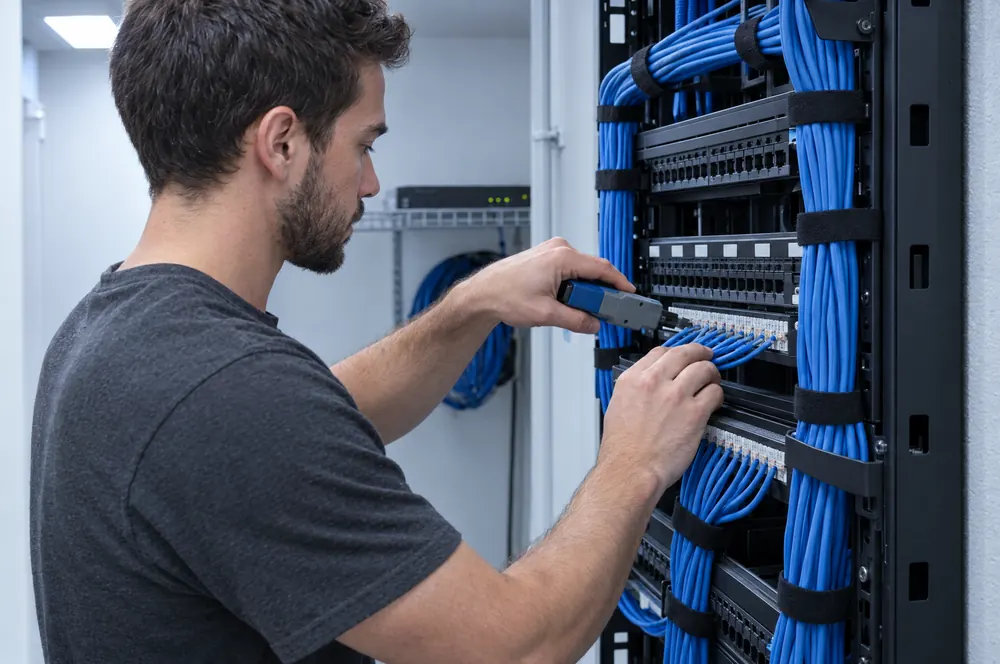
Smart-home hubs, building-automation controllers, access-control panels, IP cameras and structured cabling put your techs on client networks. Some jobs come with a remote login that stays live long after trim-out. The best-known example of a contractor login used as a doorway isn't electrical: in 2013, attackers got into Target's network with credentials stolen from a mechanical contractor that had remote access for billing and project work.
Wire fraud, social engineering and the crime policy
Business email compromise is a big, documented problem. The FBI's Internet Crime Complaint Center logged 24,768 business email compromise complaints in 2025, with about $3.05 billion in reported losses. That's across all industries, not just contractors.
The insurance problem is "voluntary parting." When your own bookkeeper sends the money, even after being fooled, basic cyber or crime wording may not pay. Coverage usually comes from a social engineering fraud endorsement, often with a sublimit far smaller than the main limit, on a cyber policy, a commercial crime policy or both. Funds transfer fraud, where a criminal instructs your bank directly, is a separate trigger. Our service bonds and crime coverage page covers the crime side.
What cyber usually covers, and what it doesn't
| What cyber typically covers | What it usually doesn't |
|---|---|
| Forensic investigation to find out what happened | A client's breach blamed on a device you installed, unless the policy includes tech E&O |
| Breach notification and credit monitoring for affected people | Physical damage from your electrical work, which is a GL question |
| Restoring lost or corrupted data | Upgrades to your systems beyond what you had, unless the form adds it |
| Ransomware and cyber extortion response | Money your staff wire to a fraudster, unless a social engineering endorsement is added |
| Business interruption while your network is down | Theft of laptops or tablets as property, which is a property question |
| Claims and regulatory defense when personal data is exposed, plus fines where insurable | Losses outside the policy's defined cyber events |
What a cyber claim can look like for an electrician
These are made-up examples. Whether a real policy responds depends on its wording.
The ransomware note on a Monday
Example scenario: A 15-person shop opens the office to find its estimating server and job files encrypted, with a ransom demand on every screen. Two bids are due Friday. A cyber policy may pay for the forensic firm, data restoration, the extortion response and lost income while the system is down.
The invoices a hacker rewrote
Example scenario: Someone gets into the owner's email and quietly sends three commercial customers copies of real invoices with new bank details. The customers pay the fake account and then refuse to pay twice. This "invoice manipulation" loss is one of the harder ones to insure, and many forms decline it. Ask about it by name.
The camera system with a factory password
Example scenario: A low-voltage crew installs IP cameras for a dental group and leaves the default admin password on the recorder. Months later, the client's network is breached and their IT firm points at the cameras. That's a claim about your professional work, not your own data, and many small-business cyber policies may not answer it.
Limits and cost for cyber coverage
Published cyber pricing for small electrical businesses is thin. One personal finance publisher puts the average at about $87 a month, or $1,041 a year, for a $1 million limit at electrical businesses with one to four employees. Larger shops, higher limits and add-ons cost more.
| Source | What it measures | Figure |
|---|---|---|
| MoneyGeek (updated September 2026) | Average for small electrical businesses, 1–4 employees, $1M limit | $87/month ($1,041/year) |
What you pay depends on your payroll and class codes, revenue, loss history, the type of electrical work you do and the limits you pick. For cyber, carriers also usually ask about security basics like multifactor login, backups and how you handle card payments.
Which electricians need cyber coverage most
- Low-voltage, access-control and smart-home installers, whose techs connect to client networks every week. See solar, EV and low-voltage contractor insurance.
- Building-automation and controls contractors with remote access to client systems.
- Service shops that take cards in the field or store customer details, alarm codes and gate codes in an app.
- Any shop that pays suppliers by wire or ACH, where one spoofed email can redirect a big payment.
A business owner's policy may offer a small data-breach add-on, but a stand-alone cyber policy usually goes further. Compare them before you choose.
Cyber rules by state
None of the state electrical licensing rules we've researched require cyber insurance. The state rule that matters is breach notification. All 50 states have laws requiring businesses to notify people when certain personal information is breached, and the details differ by state. If your customers live in several states, more than one law can apply.
A good cyber policy usually helps pay for those notifications. For a legal read on your obligations, talk to an attorney. For licensing and insurance rules where you work, see our state-by-state guide.
Related coverage
Professional liability (E&O for electricians)
Frequently asked questions
Do electricians need cyber insurance?
Does cyber insurance cover wire fraud?
How much is cyber insurance for a small contractor?
If a camera system I installed gets hacked, does cyber cover me?
Is cyber insurance part of a business owner's policy?
Ready to see what you'd pay?
Independent agents, 12+ A-rated carriers, and a licensed agent back to you within one business day.