
Home › Electrical Contractor Insurance Guides › Electrician Workers' Comp Class Codes & Audits
Workers' comp class codes and audits for electricians
A workers comp audit checks the payroll you actually paid, code by code, against the estimate your premium was built on. Most electrical work rates in class 5190, with conduit runs and line work in higher-rated codes. Surprise audit bills usually come from records that don't show which code the work fell in, who the subs were or what part of pay was overtime.
Key takeaways
- Workers' comp is priced per $100 of payroll, and each class code has its own rate. The code your crew's work lands in matters as much as the payroll.
- In most states, inside electrical work is class 5190. Conduit construction for cables or wires is 6325, and power line construction is 7538. Both usually carry higher rates.
- The premium you pay up front is a deposit. After the term, the carrier audits your real payroll by class and bills or refunds the gap.
- Surprise audit bills mostly trace to five things: mixed duties with no time split, subs with no comp certificate, overtime lumped into pay, owner or officer pay, and growth you never reported.
- Time cards coded by class, separate overtime lines and a certificate file for every sub prevent most of them.
How class codes set an electrician's comp rate
Your comp premium starts with simple math: payroll divided by 100, times the rate for each class code. Then your experience mod, a factor built from your past claims, moves that number up or down.
So two shops with the same payroll can pay very different premiums. If one crew's hours land in a higher-rated code, that shop pays more on every dollar of wages. That's why the codes on your policy deserve a look before the audit, not after.
| Class code | What it covers | Rate per $100 of payroll |
|---|---|---|
| 5190 | Electrical wiring within buildings and drivers | $0.901 |
| 6325 | Conduit construction for cables or wires and drivers | $1.277 |
| 7538 | Electric light or power line construction and drivers | $1.428 |
| 8810 | Clerical office employees | $0.073 |
These are one state's filed rates, shown only to compare the codes. Rates differ a lot from state to state, and each carrier applies its own pricing on top. What you pay depends on your payroll and class codes, revenue, loss history, the type of electrical work you do and the limits you pick. For whole-policy price ranges, see our electrical contractor insurance cost guide.
The electrician workers comp class codes to know
Most states use the class system published by NCCI, the National Council on Compensation Insurance. In those states, three construction codes cover nearly all electrical contracting work. Your carrier assigns the code, so ask what's on your policy and why.
5190 class code: wiring within buildings
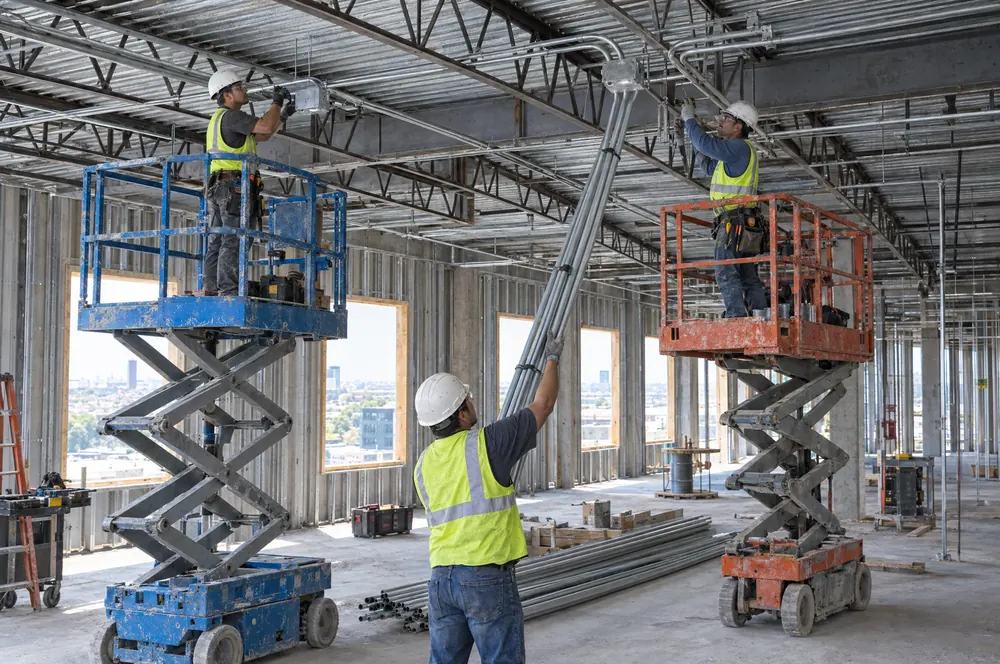
This is home base for most shops. Service changes, panel swaps, rough-in and trim-out, Level 2 EV charger circuits and fire alarm wiring inside a structure usually rate here. The drivers who haul your wire and gear are included in the code.
6325: conduit construction for cables or wires
Conduit construction outside a building, such as trenching a feed to a detached shop or setting a duct bank to parking-lot light bases, can fall in 6325. In Indiana's 2026 filing it carries a rate about 40% above 5190.
7538: power line construction
Outside crews building electric light or power lines typically land in 7538. If your shop is moving toward utility or line work, read our utility and line contractor insurance page, because the auto and liability side shifts too.
8810: the office
Office staff who never go to a job site can usually go in 8810, a far lower rate. A dispatcher who also runs parts to jobs often can't.
States with their own rating bureau
A few states run an independent rating bureau instead of relying fully on NCCI. In our footprint, that's California, Indiana, Michigan, Minnesota, New Jersey, New York, North Carolina and Pennsylvania. Most still use 5190 for inside wiring, but manuals and rules can differ.
Pennsylvania rates electrical wiring in buildings under its own code, 0661, set by the Pennsylvania Compensation Rating Bureau. See our Pennsylvania electrician insurance page.
California's rating bureau, the WCIRB, splits inside wiring by pay. Workers below a set regular hourly wage go in 5190, and workers at or above it go in 5140, which carries a lower rate. The auditor checks each worker's regular wage before allowing 5140. More on our California electrician insurance page.
How a workers comp audit works
The premium you pay at the start is a deposit based on estimated payroll. Once the policy term ends, the carrier runs a premium audit of what you actually paid, sorted by class code. Then it sends a bill for the difference or a refund.
The standard comp policy lets the carrier examine your records during the term and for up to three years after it ends.
Small shops usually answer the audit by mail or online. Larger payrolls may get an auditor at the office.
What the auditor usually asks for
- payroll reports for the full policy period, by employee
- quarterly Form 941 filings, W-2s and the W-3
- 1099s, plus a comp certificate for every sub you paid
- each worker's job duties, and time records split by class
- owner and officer pay, plus any exclusion or election forms
- the general ledger or check register, to find labor paid outside payroll
Audited payroll also feeds your experience mod. A messy workers compensation audit can cost you twice: once on the bill, and again at renewal.
Don't ignore the notice. Many states let carriers attach an audit noncompliance endorsement. Under it, a shop that won't cooperate can be charged as much as double its estimated yearly premium, and the policy can be canceled.
Why electricians get surprise workers comp audit bills
Most audit bills come from paperwork, not from fraud or bad luck. Here are the five spots where electrical shops get caught.
1. Mixed duties with no time split
Your journeyman pulls wire inside buildings most weeks and trenches conduit outside for a few. Under NCCI-style rules, you can split his pay between 5190 and 6325 only if your records show the actual hours in each. Estimates and percentages don't count. With no split, all of his pay goes to the highest-rated code he worked in.
2. Subs with no comp certificate
If you pay a sub who can't prove its own comp coverage, the auditor can add that pay to your payroll. Under NCCI-style rules, that's at least 90% of a labor-only price or 50% of a labor-and-materials price, rated in the code that fits the sub's work. Our guide to 1099 subs and workers comp covers this in full, and our certificate of insurance guide shows what to check on a sub's COI.
3. Overtime lumped into regular pay
Many states let you leave out the premium portion of overtime, the extra "half" in time-and-a-half. You get that break only if payroll records show overtime by employee. If overtime is recorded at the full time-and-a-half rate, one-third of that pay comes out. Some states don't allow the exclusion at all.
4. Owner and officer pay
These rules depend on your business type and state. Sole owners and partners are often left out unless they elect coverage. Corporate officers are often counted, within state minimum and maximum payroll amounts, and some states let officers opt out with a filed form. If the form isn't on file, expect their pay to count.
5. Growth you never reported
You hired two apprentices in March and picked up a commercial tenant fit-out in June. The policy still shows last year's payroll. The audit bills all of it at once, months after the money is spent.
Example scenario: An Indiana service shop estimates $380,000 of payroll in 5190. By audit time, two new apprentices have pushed actual 5190 payroll to $460,000, which adds about $721. A journeyman and a helper also trenched conduit for a solar array feed, but their time cards never split those hours. All $110,000 of their pay moves to 6325, adding about $414 more.
The shop also paid $24,000 of time-and-a-half pay that payroll never broke out, so the $8,000 overtime premium inside it counted, about $72. That's roughly $1,206 in extra premium before the mod and carrier factors, and paperwork could have prevented about $486 of it.
Ohio BWC and Texas non-subscribers
Two states in our footprint handle comp differently, and both change what an audit looks like.
Ohio: the state fund and the payroll true-up
Ohio employers buy comp from the Ohio Bureau of Workers' Compensation, not from private carriers. Instead of a carrier audit, private employers file a yearly payroll true-up with BWC after the policy year, which runs July 1 to June 30. BWC then bills the shortfall or credits the overage.
The state-fund policy doesn't include employer's liability. Ohio shops often add stop-gap employer's liability, usually as an endorsement on their general liability policy. Details are on our Ohio electrician insurance page.
Texas: no comp policy, no comp audit
Texas lets most private employers opt out of comp. Those shops are called non-subscribers, and with no comp policy there's no comp audit.
The trade-off is lawsuit exposure. A hurt employee can sue the shop for negligence, and Texas law strips a non-subscriber of its usual defenses, such as blaming the injury on the employee's own carelessness or on a fellow worker.
Public building and construction contracts in Texas also require comp, including from subs. That's why many growing Texas shops move onto a comp policy. Read more on our Texas electrician insurance page, and get advice from a Texas employment lawyer before your shop leaves the comp system.
Records that keep your workers comp audit clean
Most of this is setup at the start of the policy year, not extra work at the end. Here's the move.
- Confirm your codes. Ask your agent which codes are on the policy and what work each one covers. Flag any new work type, like solar, underground or line work.
- Code time cards by class. When one worker does both 5190 and 6325 work, track the hours in each, every week.
- Pay overtime on its own line. Keep it separate by employee in your payroll system.
- Collect sub certificates before day one. Check the policy dates again before the final payment.
- Keep sub contracts and invoices that show labor only or labor and materials.
- File owner and officer forms. Keep exclusion forms or coverage elections on hand.
- Report big payroll jumps mid-year. A mid-term update to your estimate beats a large bill later.
- Tie out to your 941s. Match your audit payroll to your quarterly filings before you send anything.
For how the policy itself is built, see workers comp insurance for electricians.
How to dispute a workers comp audit bill
Audits can be wrong. Auditors work from what you hand them, and a missing certificate or a lumped payroll report looks the same as real exposure.
Ask for the audit worksheet and check each code, each payroll line and each sub charge. If a sub was insured, send the certificate. If a worker landed in the wrong code, send time records and job duties.
Your agent can take the request to the carrier's audit team and ask for a re-audit. If that doesn't settle it, your state's insurance department or rating bureau may offer a dispute process.
Frequently asked questions
Why is workers comp auditing me?
Do workers' comp audits happen every year?
What records are reviewed during a workers comp audit?
What happens if I ignore a workers comp audit?
What is class code 5190?
Verdict on the workers comp audit
A workers comp audit isn't a trap. It's math done on your records. Electricians get surprise bills when those records don't show which code the work fell in, who the subs were or what part of pay was overtime. Know your codes, track hours by class, collect sub certificates before work starts and tell your agent when payroll grows. When you're ready to compare comp options for your shop, start your quote.
Want a second set of eyes on your coverage?
Independent agents, 12+ A-rated carriers, and a licensed agent back to you within one business day.