
Home › Coverages › Business Owner's Policy for Electricians
A business owner's policy for electrical shops
A business owners policy packages general liability, property coverage for your shop and its wire and parts inventory, and business income into one policy, often for less than buying each piece separately. Smaller residential and light-commercial electrical shops are the usual fit, while high-voltage, utility, alarm and larger commercial shops often fall outside a BOP program's rules.
- Since 2003
- 12+ A-rated carriers
- 28 states
- Independent agents
Start your electrician insurance quote
Takes about a minute. A licensed agent follows up.
Licensed in 28 states · NPN 7642818 · Since 2003
What a business owners policy bundles for an electrical shop
A business owners policy, or BOP, combines three coverages that a small shop would otherwise buy one at a time:
- General liability for injuries and property damage your business causes to others
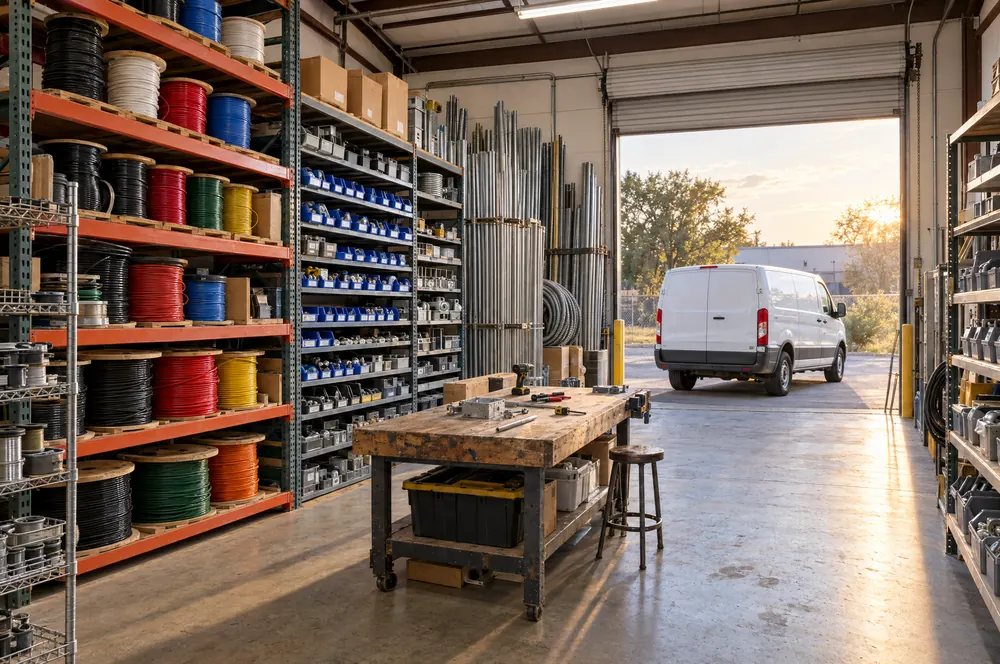
- Commercial property for the building you own or rent, your office equipment, and the spools, breakers, devices and fixtures on your shelves
- Business income, which replaces lost income while covered damage to your premises is repaired
Because it's a package, a BOP often costs less than buying those pieces separately. Equipment breakdown coverage can often be added.
A BOP leaves out workers' comp, commercial auto, professional liability and cyber. Those are separate policies.
What a BOP usually covers for electricians
| What it usually covers | What it usually doesn't |
|---|---|
| Liability claims from your operations and completed work | Your vans and trucks; that's commercial auto |
| Your shop building, if you own it, and improvements if you rent | Injuries to your own crew; that's workers' comp |
| Wire, conduit, breakers and fixtures stocked at the shop | Design or load-calc errors; that's professional liability |
| Lost income while a covered loss keeps the shop closed | Data breaches and payment fraud; that's cyber |
| Equipment breakdown, when added | High-voltage, utility or alarm work in many programs |
How a BOP pays out in an electrical shop
These examples are fictional. Each one touches a different part of the package.
Example scenario: the warehouse fire
Example scenario: A battery charger left plugged in overnight starts a fire in a shop's back room. It burns racks of MC cable, boxed LED fixtures and a stack of panelboards waiting for a remodel. The property part of the BOP may pay to replace the stock and repair the room. Business income may cover lost profit while the shop is closed for cleanup.
Example scenario: the rooftop unit that quit
Example scenario: The rooftop HVAC compressor on a shop's leased building fails during a heat wave. The shop is responsible for it under the lease. If equipment breakdown was added to the BOP, it may pay for the repair. Without it, a mechanical failure like that usually isn't a covered property loss.
Example scenario: the visitor on the stairs
Example scenario: A sales rep visiting the shop to demo a new line of smart breakers trips on a coil of wire left on the stairs. The liability part of the BOP may respond to the medical bills and any lawsuit.
Who qualifies for a BOP, and who doesn't
Limits, add-ons and cost
Many electrical shops buy the BOP's liability side at $1 million per occurrence and $2 million aggregate, then set property limits to the replacement cost of the building and stock. One large online insurance marketplace reports a median near $100 a month for electricians' BOPs at those liability limits.
What you pay depends on your payroll and class codes, revenue, loss history, the type of electrical work you do and the limits you pick.
Equipment breakdown
This add-on covers sudden mechanical or electrical breakdown of equipment in your building, such as the HVAC, an air compressor or the building's electrical service. Standard property coverage often excludes that kind of failure.
Business income
Business income pays lost net income and continuing expenses while covered damage keeps you from operating. For a shop whose stock and office are in one building, that matters more than many owners think.
Cyber isn't in the box
A BOP doesn't include cyber coverage. The standard GL form inside it excludes electronic data losses, and ISO's 2014 endorsements exclude claims tied to access or disclosure of personal information. The FBI's crime center logged about $3.05 billion in business email compromise losses in 2025, and a fake supplier email asking you to change wire instructions is one version of that. See cyber liability for electricians.
Which electrical shops a BOP fits
The best fit is a one- to three-van residential and light-commercial shop with a small office or warehouse. That's the shop doing panel swaps, service calls, remodels and tenant work under three stories. See insurance for residential electricians.
The property side is built around your premises. Meters, pullers and benders that ride in the van usually belong on a tools and equipment policy instead.
Industrial, high-voltage, line, alarm and larger commercial shops usually need separate general liability and property policies. That's not worse coverage. It's just built for a bigger risk.
When you outgrow the package
Growth is usually what pushes a shop out of a BOP. Watch for these triggers before renewal, not after a claim:
- your first job above three stories or your first switchgear lineup over 480 volts
- a new alarm, access-control or fire alarm service line
- payroll or revenue passing your program's caps
- subbing out a bigger share of the work as you take on larger commercial packages
Tell your agent when any of these happen. Moving to a separate GL and property program mid-term is cleaner than finding out at claim time that the work didn't fit.
BOPs and state rules
BOP eligibility is set by carriers, not states, so no state electrical license rule we found requires one. Two state points still shape what you buy alongside it:
- Ohio: a BOP never includes workers' comp, and in Ohio comp comes only from the state fund (BWC). Private carriers can add stop-gap employer's liability.
- Ohio license rules also tie the license to a named person assigned to the company. If that person leaves and no replacement is assigned within 90 days, the assignment lapses. Plan for that before it stalls open jobs.
For other states' license and insurance rules, see our state pages.
Related coverage
Frequently asked questions
Can an electrical contractor get a business owners policy?
Does a BOP cover my tools in the van?
Is a BOP cheaper than separate GL and property policies?
Does a BOP include workers' comp or commercial auto?
What is equipment breakdown coverage?
Ready to see what you'd pay?
Independent agents, 12+ A-rated carriers, and a licensed agent back to you within one business day.