
Home › Coverages › Utility & Line Contractor Insurance
Insurance for utility, line and underground electrical contractors
Utility contractor insurance for line, underground and boring crews has to handle energized conductors, bucket trucks, buried-utility strikes and the bigger limits utilities write into their contracts. Many standard small-business programs won't write this work, so the right coverage usually comes from specialty markets an independent agent can reach.
- Since 2003
- 12+ A-rated carriers
- 28 states
- Independent agents
Start your electrician insurance quote
Takes about a minute. A licensed agent follows up.
Licensed in 28 states · NPN 7642818 · Since 2003
Where utility contractor insurance claims come from
Utility contractor insurance is built around four exposures inside wiring never sees: energized lines overhead, heavy trucks with booms, utilities you can't see underground, and public streets you have to open. Each one pulls in a different policy.
Energized lines
OSHA splits line work into two standards. Building new transmission or distribution lines, or altering existing ones, falls under 29 CFR 1926 Subpart V. Operating and maintaining generation, transmission and distribution equipment, including line-clearance tree trimming, falls under 29 CFR 1910.269, which expressly doesn't apply to construction.
Employers that comply with 1910.269 are treated as complying with most of Subpart V. For insurance, the point is simpler: tell your carrier which kind of work your crews do, because it changes how they're classed and priced.
Booms and derricks
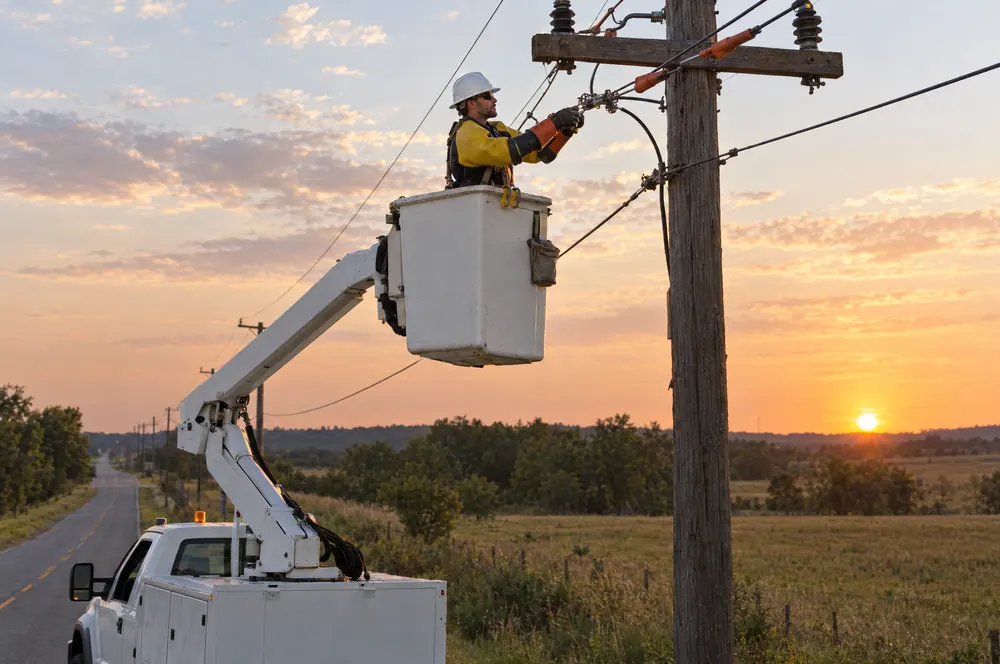
A bucket truck is a road vehicle, an aerial work platform and a piece of contractor's equipment all at once. A digger derrick adds auger work and pole setting to the list.
What's underground
Trenching for conduit and boring under driveways or roads puts your crew next to gas, water, fiber and other electric lines nobody can see.
The public right-of-way
Streetlight bases, traffic-signal conduit and service laterals often run through city property, which brings permits, bonds and certificates before the first cut.
The coverage stack for line and underground contractors
The first four are must-haves for a line or underground crew. The last three follow your contracts.
General liability (must-have)
Classified for power line or conduit work, not just inside wiring, with completed operations in place. General liability for electricians
Workers' comp (must-have)
Lineworkers and underground crews rated under their own class codes. Workers' comp for electricians
Commercial auto (must-have)
Bucket trucks, digger derricks, pole trailers and crew trucks on the road. Commercial auto for electricians
Contractor's equipment (must-have)
Boring rigs, trenchers, wire pullers, tensioners and, depending on the carrier, the aerial device itself. Tools and equipment insurance
Umbrella (often needed)
The usual way to reach the higher per-occurrence limits utilities and co-ops ask for. Umbrella insurance
Performance and payment bonds (often needed)
Surety for public, municipal and co-op contracts. Performance and payment bonds
Permit bonds (often needed)
Right-of-way and street-opening bonds cities require before you dig. License and permit bonds
High-voltage work changes who will write you
Bucket trucks and digger derricks: three policies, one truck
Example scenario
Directional boring and buried-utility strikes
What utilities, co-ops and cities will ask you for
Utility contracts usually spell out limits in an insurance exhibit, and they often run higher than the $1M per occurrence and $2M aggregate a small shop starts with. Western Farmers Electric Cooperative, an Oklahoma generation-and-transmission co-op, is one example. Its contractor requirements call for:
- $2 million per occurrence for general liability and for auto liability
- $2 million of completed-operations coverage that runs for the contract term plus two years
- workers' comp as required by law
- an excess or umbrella policy to reach those limits, if it follows the form of the underlying policies
Requirements vary by utility and by contract, so read the exhibit before you bid. Expect additional insured, waiver of subrogation and primary and non-contributory wording to show up there too.
Public streets bring their own paperwork. Before you trench a sidewalk for streetlight conduit or bore under a road, expect the city to ask for a right-of-way permit, and often a bond plus certificates, before it issues one. In New York City, DOT registers street-opening permittees with GL and comp certificates on file and a permit bond where applicable. In Nashville, Metro sets the excavation bond at $40,000 and wants $1 million or more of GL with Metro named as an additional insured. Every city sets its own amounts.
On public bids, federal construction contracts over $150,000 need performance and payment bonds under FAR 28.102-1, and states set their own rules. NASBP says those two bonds together generally cost 0.5% to 3% of the contract price.
Growing into utility and line work
Line and underground work pays well, but every step into it changes your file. Plan these with us before they happen:
- Your first pole or conduit job. Reclassify GL and comp first, not at audit.
- Your first bucket truck or derrick. Settle the auto, GL and equipment split, and insure the full upfit value.
- Your first boring rig. Check for an XCU exclusion and schedule the rig on your equipment policy.
- Your first co-op or municipal contract. Match the limits, the completed-operations term and the bonds before you sign.
Licensing can change too. Texas licenses journeyman linemen through TDLR. Florida's certified specialty electrical contractor license includes a utility line scope. Georgia issues a separate utility contractor license and utility manager certificate. See Texas, Florida and Georgia for details, or check your own board through our state-by-state pages.
Frequently asked questions
What insurance does a utility contractor need?
Does my auto policy cover a bucket truck's boom?
Am I covered if we hit a gas line while directional boring?
What workers' comp code do lineworkers use?
How much liability insurance do utilities require from contractors?
Ready to see what you'd pay?
Independent agents, 12+ A-rated carriers, and a licensed agent back to you within one business day.